
What’s Really Separating Winning Pharma Launches From the Rest

April 23, 2026
One thing I keep coming back to when I look at pharma launches over the last few years is this: We still talk about approval as if it’s the finish line.
It isn’t.

In today’s market, approval is the moment the real test begins. The companies that win are not just the ones with strong science. They’re the ones that can turn that science into access, uptake, and operational reality at scale. That’s the central pattern in your report: launches have become both more valuable and more fragile at the same time.
To me, that is the real story behind recent pharma performance.
Yes, we’ve seen astonishing commercial upside. Lilly’s tirzepatide franchise is the clearest example. Mounjaro grew from $0.48B in 2022 to $22.97B in 2025, while Zepbound rose from $0.18B in its partial 2023 launch year to $13.54B in 2025. Those are extraordinary numbers. But they also reinforce an important point: even when demand is overwhelming, performance still depends on supply, channel expansion, and the ability to reduce friction in access.
At the same time, some of the most important lessons are coming from launches that did not achieve escape velocity.
Aduhelm is one example. Roctavian is another. Both remind us that a headline approval can still underdeliver commercially when the launch runs into controversy, coverage constraints, treatment-center readiness issues, payer complexity, or patient-finding challenges. Roctavian, despite FDA approval, generated just $36M in 2025 revenue before being withdrawn. That is a powerful reminder that commercial success is often gated by infrastructure, not just product value.
That’s why I think the industry needs to be more honest about what actually drives launch performance now.
It’s not just brand strategy.It’s not just field execution.And it’s definitely not just regulatory success.
What increasingly determines outcomes is whether the launch system works: reimbursement, stakeholder alignment, site readiness, specialty pharmacy and hub design, retail reach where relevant, manufacturing reliability, and an evidence plan strong enough to hold up under real-world scrutiny. The report makes this point clearly: launchability increasingly depends on what happens after approval, including reimbursement, guidelines, capacity, and distribution engineering.
I also think this is where many launch teams still underestimate the level of friction in the system.
In Europe, for example, only 46% of innovative medicines centrally approved in the 2020–2023 cohort had public reimbursement across the EU27 as of January 2025. That means the gap between regulatory success and real patient access is not theoretical. It is measurable.
And in advanced therapies, the challenge is even sharper. These are not traditional launches. They are network launches. They depend on treatment-center activation, logistics, contracting, patient identification, and throughput. In other words, they succeed or fail based on whether the surrounding care model is ready.
That’s why the launch leaders I’d bet on going forward are the ones asking different questions earlier: Are we designing for access early enough?Are we treating capacity planning as seriously as sales planning?Are we measuring real adoption, not just top-line revenue?Are we prepared for evidence risk, policy risk, and channel friction before they show up in market?
Because the truth is, “great launch performance” means something different than it did a few years ago.
It is no longer enough to ask whether a product launched with strong awareness or initial demand. A modern launch scorecard has to look at coverage breadth, time to reimbursement, prescription uptake, patient starts, market share, supply reliability, treatment-center activation, and gross-to-net reality. The best teams are separating real uptake from noise and building a much more disciplined view of performance.
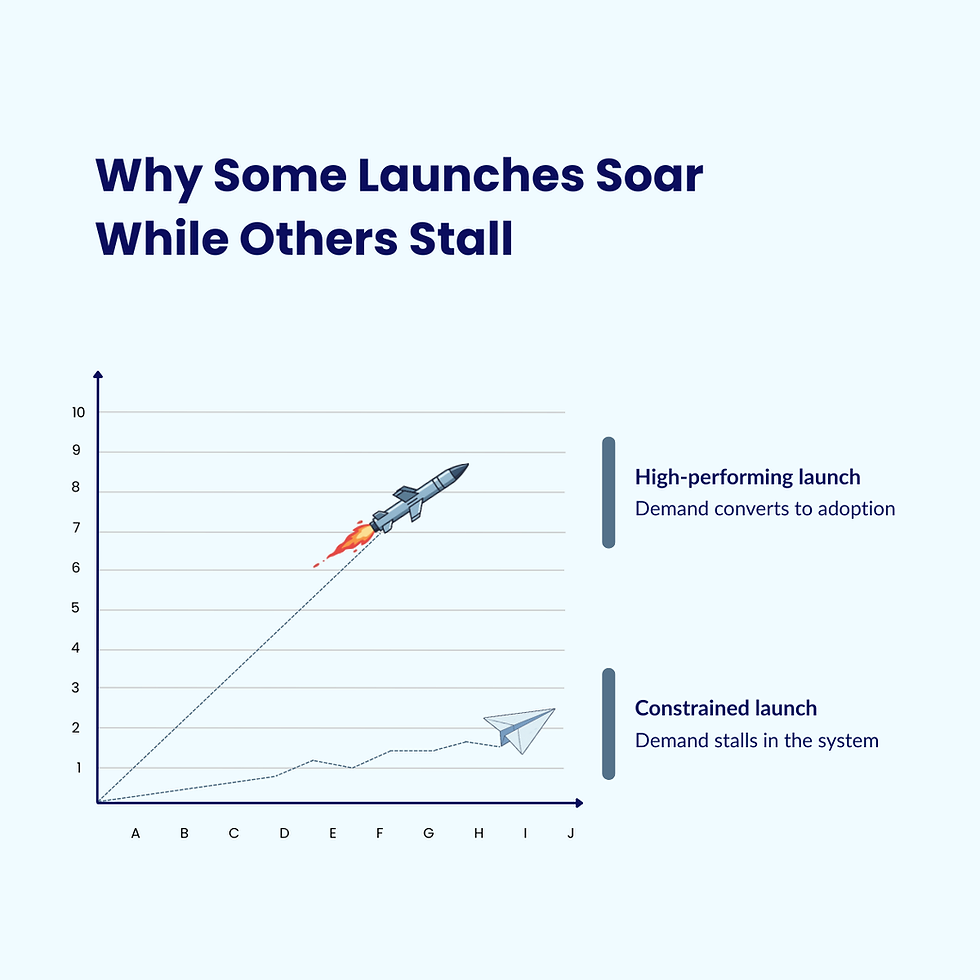
My biggest takeaway from this report is simple: The pharma industry is not struggling with innovation. It is struggling with conversion.
Converting approval into access.Converting demand into fulfilled treatment.Converting clinical promise into scalable commercial reality.
The next generation of launch winners will not just be the companies with the most exciting assets. They’ll be the ones that understand launch as a full-system challenge — one that connects evidence, access, operations, channel strategy, and stakeholder activation from day one.


Comments