
The $300B Cliff: Why 2026 is the Year Pharma Launches Either Evolve or Go Extinct

February 9, 2026
The pharmaceutical industry has officially entered its most volatile era. As we move through 2026, the "Blockbuster Model"—the reliable, multi-billion-dollar engine that sustained the industry for decades—is stalling.

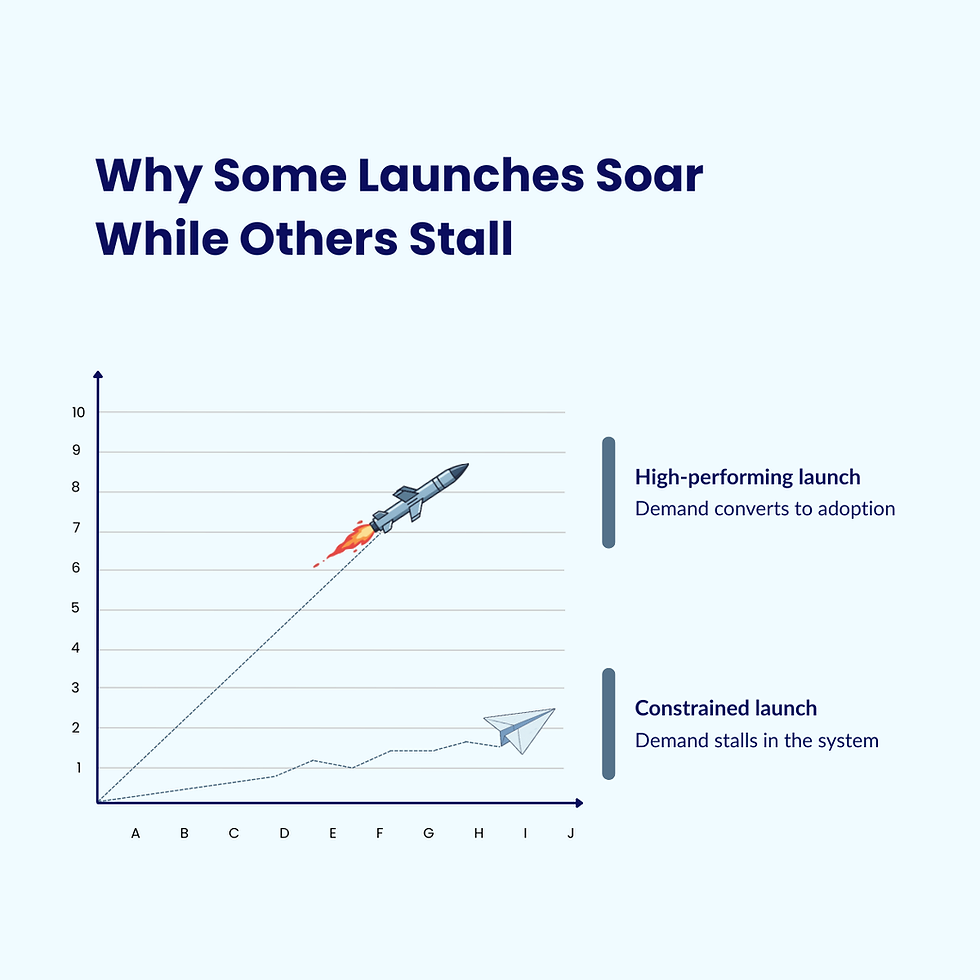
Between now and 2030, an estimated $300 billion in annual global revenue is at risk due to a massive "patent cliff." Historically, pharma would simply launch its way out of such a hole. But in 2026, the launchpad is crumbling. Recent data reveals that nearly 60% of new patients are being met with "durable rejections" from payers, and the time it takes for a drug to reach peak sales has stretched by years.
The message for C-suite leaders is clear: The old launch playbook isn't just outdated; it’s a liability. Here is the state of the 2026 launch landscape and the radical strategies the winners are using to survive.
1. The Triple Threat: Why Launches are Failing
The "Launch-to-Value" gap is widening, driven by three converging forces that have reached a breaking point this year.
A. The Payer "Iron Curtain"
Payers have transitioned from managing costs to actively suppressing adoption. In 2026, we are seeing AI-driven audits where insurers deny high-cost claims with 20% more frequency than just two years ago. Even if a drug is clinically superior, "step therapy" and aggressive prior authorization are keeping it out of patients' hands.
B. The Inflation Reduction Act (IRA) "Event Horizon"
The implementation of the IRA has introduced a new "Medicare Event Horizon." For small molecules, the clock for price negotiations starts at just 9 years, effectively shortening the economic lifecycle of a drug regardless of its patent life. This is forcing companies to launch with "peak value" pricing on Day 1, leaving no room for the traditional slow-burn adoption.
C. The Physician Engagement Paradox
Doctors are exhausted. The average specialist now receives over 30 industry interactions per year, leading to a "noise" problem. Only 20% of providers are early adopters of new therapies; the rest are waiting for three to four years of real-world evidence (RWE) before they change their prescribing habits.
2. Solving the Crisis: The 2026 Survival Playbook
The companies successfully navigating this "cliff" are not just working harder; they are working differently. They have pivoted from traditional commercialization to Precision Launch models.
I. From Sales Reps to "Agentic AI"
AI is no longer a pilot project—it is the core of the 2026 budget. Leading firms have replaced broad sales territories with Agentic AI systems. These systems:
Identify "High-Impact Accounts" by analyzing referral pathways in real-time.
Automate adverse event reporting and FAQ handling, reducing response times from 72 hours to seconds.
Enable "Sales-Lite" models where AI manages the routine education, allowing human reps to focus only on high-value clinical deep dives.
II. The Rise of "Direct-to-Patient" (DTP) Ecosystems
To bypass payer friction, pharma is building its own infrastructure. In a landmark shift, major manufacturers have launched branded digital platforms that connect patients directly with telehealth providers and specialty pharmacies. By controlling the ecosystem, they reduce "patient abandonment"—where a patient leaves the pharmacy empty-handed because of a surprise $500 co-pay.
III. Real-World Evidence (RWE) as the New Currency
Because payers no longer trust Phase III clinical data in isolation, the winners of 2026 are launching with "Data-Ready" packages. They are using RWE from the Middle East (specifically Saudi Arabia’s Breakthrough Medicine Programme) and other early-launch regions to prove value to US and EU payers before the first domestic script is even written.
IV. Resilience Through "U.S.-First" Manufacturing
Geopolitical volatility and new 15% tariffs on pharmaceutical imports have made global supply chains a risk. Companies are now utilizing Digital Twins to stress-test their supply chains, reshoring production to avoid the multibillion-dollar cost spikes that can kill a launch’s margin in its first six months.
3. In closing
The $300B patent cliff is not just a financial hurdle; it is a Darwinian filter. The companies that continue to rely on "broad-reach" marketing and traditional payer negotiations will see their margins evaporate.
The winners of 2026 are those who treat a drug launch not as a product release, but as the deployment of a technological and clinical ecosystem. They aren't just selling a pill; they are managing the data, the access, and the patient experience with surgical precision.

Comments