
Launch Excellence Leadership & Governance in Pharma: What “Best Practice” Looks Like (and What the Evidence Supports)

February 24, 2026
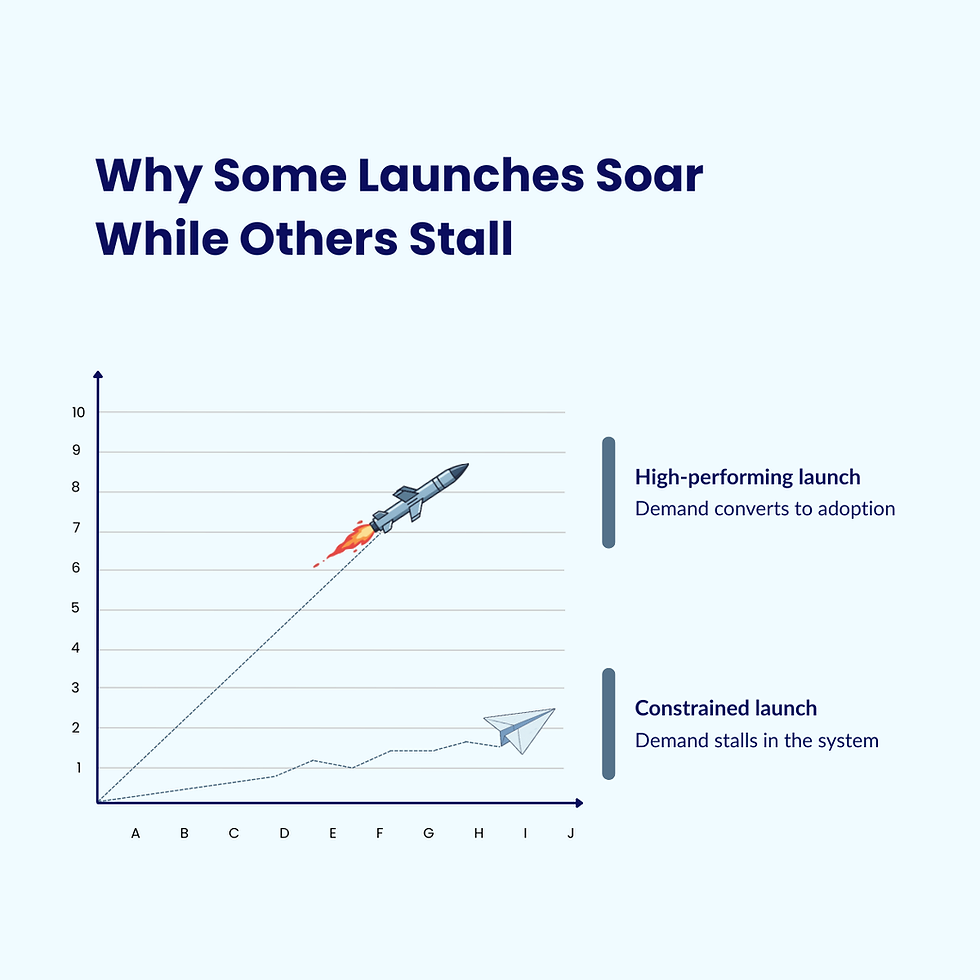
Pharmaceutical launches are unforgiving: early performance is hard to “make up” later, and complexity spans evidence generation, regulatory, supply, medical, access, and commercial execution. One large analysis summarized in a McKinsey launch compendium found that about two-thirds of 210 launches (new molecular entities, 2003–2009) missed pre-launch consensus first-year sales expectations, and that early underperformance often persisted. That dynamic is why “launch excellence” is less about heroic execution at approval and more about leadership and governance systems that consistently make good decisions, early, across functions and geographies.
Below is what best practices look like when you translate those lessons into an operating model you can run repeatedly—without relying on luck or a few launch veterans.

1) Treat launch governance as a decision system, not a meeting cadence
In strong launch organizations, governance exists to do three things well:
Create decision clarity (who decides what, by when, using what evidence)
Surface and resolve cross-functional tradeoffs (e.g., speed vs. data completeness; supply risk vs. market opportunity)
Maintain organizational control as work scales across regions, vendors, and internal teams
McKinsey’s operations-focused launch guidance is explicit that launch excellence requires deliberate governance, process control, and performance management, including mechanisms to escalate issues and decide quickly.
Best-practice behaviors
Publish a decision-rights map (e.g., a RACI/DRI model) that separates: recommendation owners, approvers, and consulted reviewers.
Use time-bound decision “windows” tied to milestones (labeling, pricing/market access sequencing, supply build, channel strategy).
Define escalation triggers (objective thresholds, not “if it feels risky”).
Why this matters: in regulated environments, delays often come from rework (late objections, mismatched assumptions, missing evidence), not from the calendar. Governance reduces rework by making decisions explicit and auditable.
2) Build a two-tier structure: empowered core team + executive steering committee
A common launch anti-pattern is a large cross-functional team that meets frequently but lacks authority to resolve conflicts. High-performing models use two tiers:
Tier A: Cross-functional launch team (execution + integration)
McKinsey’s operational best-practice list recommends setting up a cross-functional team spanning (as relevant) QA/QC, regulatory, manufacturing, supply chain, engineering, and more—led by an experienced, full-time project manager.
Best practices
Staff key roles full-time in the most intense phases (pre-submission through post-launch stabilization).
Assign single accountable owners per workstream (not co-owners).
Formalize interfaces between Medical, Commercial, Market Access, Regulatory, Safety, CMC/Supply so handoffs aren’t ad hoc.
Tier B: Steering committee (strategy + fast decisions)
McKinsey also calls for a strong governance body to escalate complications and “make decisions as quickly as possible,” including joint steering committees in complex transfer/partnering scenarios.
Best practices
Keep it small (true decision-makers).
Focus agendas on exceptions and tradeoffs, not routine updates.
Hold members accountable for decision latency (time from issue raised → decision made).
3) Use gated “launch readiness” reviews that are evidence-based—not PowerPoint-based
Many companies claim to run “readiness,” but best practice is to run it like a quality system: defined criteria, traceable evidence, and a clear disposition.
McKinsey’s operations guidance recommends readiness checklists that cover items such as SOPs, change controls, validation protocols, training, batch records, gap/risk analysis, and facility fit, plus milestone-based maturity tracking.
Best practices
Define readiness gates across major dimensions:
Regulatory & labeling (submission completeness, inspection readiness, labeling negotiations)
CMC & supply (PPQ/validation completion, release testing, distribution readiness)
Quality system (deviations/CAPA readiness, complaint handling, stability program)
Medical & safety (PV system readiness, medical inquiry handling, risk minimization readiness where applicable)
Market access (payer evidence, dossier readiness, contracting capabilities)
Commercial (training/certification, compliant materials, channel execution)
Require objective evidence artifacts (approved documents, test results, training completion logs), not subjective “green” status.
This is where governance earns its keep: readiness gates force early surfacing of “unknowns,” and leadership ensures tradeoffs are decided—not deferred.
4) Embed Quality Risk Management into governance (not as an afterthought)
In pharma, the strongest argument for disciplined governance is patient protection: decisions should be science-based and risk-based.
ICH Q9 (Quality Risk Management) states that risk-based decision-making is inherent in quality risk management and should be systematic across the product lifecycle.
Best practices
Make QRM the language of governance: each major decision memo includes (1) risks, (2) probability/severity, (3) mitigations, (4) residual risk acceptance owner.
Calibrate effort to risk (Q9 emphasizes the level of formality/documentation should be commensurate with risk).
Use risk reviews to prioritize launch work (what must be perfect vs. what must be “good enough” now with a planned improvement).
This approach keeps teams aligned when timelines tighten: you’re not arguing opinions; you’re making explicit risk choices.
5) Make senior management responsibility real (ICH Q10) and visible in the launch system
ICH Q10 frames a pharmaceutical quality system across the lifecycle and explicitly includes management responsibility—including management commitment and management review.
Best practices
Tie launch steering agendas to a management review rhythm: systemic issues, resourcing, supplier risks, and changes that could affect product quality or compliance.
Ensure leaders sponsor the “hard wiring”:
resourcing decisions
escalation pathways
accountability when milestones slip
Treat quality as a core governance dimension, not a function that “approves at the end.”
Launch excellence is fragile when quality leadership is peripheral; it becomes repeatable when quality oversight is built into the decision system.
6) Govern the full lifecycle: plan for post-approval change and supply resilience early
Launch isn’t the finish line; it’s the start of lifecycle execution. ICH Q12 provides a framework to manage post-approval CMC changes more predictably and efficiently, supporting continual improvement while maintaining assurance of supply and quality.
Best practices
Establish a launch-to-lifecycle governance handoff:
what moves from “launch program” into “lifecycle governance”
who owns post-approval improvements (tech transfer optimizations, second-source qualifications, scale changes)
Build a change roadmap alongside the launch roadmap (what you will improve after stability is proven, and how you’ll manage regulatory impact).
This reduces the common problem where launch teams disband and improvements stall—or worse, changes happen without coherent oversight.
7) Run performance management like a cockpit: transparent metrics + fast problem-solving loops
McKinsey’s operational playbook recommends a standardized “launch cockpit” for KPI-based progress tracking and transparent responses to deviations.
Best practices
Track a balanced set of indicators:
Readiness leading indicators (training completion, batch release timelines, material approvals)
Execution indicators (on-time milestone delivery, deviation rates, supply service levels)
Outcome indicators (early demand signals, access wins, safety signal handling timeliness)
Make it safe (and expected) to surface red statuses early—governance that punishes bad news creates blind spots.
8) Ensure compliant external communication governance—especially for payer and pre-approval contexts
Launch governance must also ensure that external communications are compliant and appropriately controlled. The FDA has specific guidance addressing manufacturer communications with payors/formulary committees, including questions related to dissemination of health care economic information and information about products not yet approved or cleared.
Best practices
Separate (but coordinate) Medical, Regulatory, Legal, and Commercial review lanes for:
payer/value communications
scientific exchange
promotional materials (post-approval)
Implement tight version control and training completion tracking for field-facing materials.
A practical way to operationalize this is to make “comms readiness” a formal gate with required evidence.
A practical “best practice” blueprint (putting it together)
If you want a compact operating model that reflects the evidence above, it looks like this:
Launch governance charter: purpose, scope, success metrics, decision rights
Two-tier structure: launch team (integration/execution) + steering committee (decisions/escalations)
Readiness gates with evidence: checklists + maturity tracking + formal dispositions
Risk-based decisions: QRM embedded in every major tradeoff
Management accountability: management review and resourcing aligned to launch realities
Lifecycle handoff: post-approval change strategy designed early
Launch cockpit: transparent metrics and a rapid issue-resolution loop
Compliant communications governance: payer and external dissemination controls
Closing thought: the hallmark of launch excellence is consistency
The most important theme across the evidence is that launches fail less from a single catastrophic mistake and more from compound small misses: late decisions, unclear ownership, unmanaged risk, and inconsistent execution. The governance practices above are designed to prevent “things falling between the cracks”—a phrase McKinsey uses directly when describing why launch fundamentals matter.

Comments